 |
| The
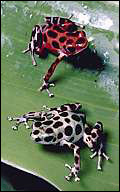
variable form on Bastimentos Island. This shows two of
the color forms from the same population. |
Another
characteristic that makes this species unique is the tremendous
divergence that has taken place in a small part of its range.
On Bastimentos, an island with an area of only 52 square kilometers,
there is diversity within this species that is rarely found
among vertebrates. Located in the Bocas del Toro Archipelago
on Panama's Caribbean coast, it is only one of many islands
that the strawberry poison frog inhabits. But nowhere else
does the variation show up with such clarity. On this tiny
island there are at least three distinct populations. One
is a completely bright orange frog from head to toe. Most
of the specimens are
spotless, but some have small black specks on their backs.
The second form has a reddish-orange back,
white belly and dark legs. It is unique among this species
in that its skin is very granular, which gives its back a
rough, bumpy look. The third population is the most plentiful
and interesting. Their backs range in color from red to yellow
including pale red, light orange, gold and a washed-out green.
They may have no spots, tiny spots, large spots, broken stripes,
or solid stripes of black on their backs.
| |
|
| |
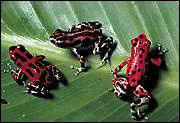
Same
form as in above photo, but showing the variation in markings. |
These
differences not only occur on the islands, but the mainland
as well. On the western shore of the bay in the hills above
the town of Almirante, the species is large and red with dark
legs. Here it looks closer to its relatives across the border
in Costa Rica than in any other part of Panama. But if you
travel farther south to a point on the mainland across from
the island of Split Hill, you find a much smaller, dark blue
frog. Continue south along the shore and there is a tiny,
black and white version of the same species. Even farther
south, down the road from Chiriqui Grande, the frogs are green
or yellow-green with light bellies and bluish legs.
The animals
living on the islands seem to have an advantage over their
mainland relatives for now. The frogs of Bastimentos have
been lucky in that there has been little development on the
island and the present settlements are small. Much of the
primary forest remains in and around the town of Bastimentos
where frogs from the highly variable population can be seen
hopping across the pathways and in gardens of impatiens. But
other groups on the mainland have not been as fortunate. John
and Anthony have traveled through this part of the country
numerous times in the past, and many of the sites where this
species had been prolific are now razed. An area where the
black and white color form thrived was turned into a large
cacao plantation. Another site was found nearby where this
form is abundant, but a wide dirt road cuts through the forest
and there are plans to pave it in the future. Paved roads
are usually precursors to forest destruction in many parts
of Central and South America.
|
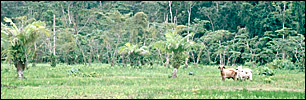
| Cattle
in a field cleared for grazing. |
|








 Walk
a Tropical Stream at Night
Walk
a Tropical Stream at Night