 |
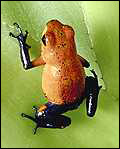
| The
common form of Dendrobates pumilio. |
The strawberry
poison frog, Dendrobates pumilio, is commonly found
along the Caribbean lowland forests from Nicaragua to western
Panama. In Nicaragua and Costa Rica it is a small, red frog
averaging less than 20 mm in length. Its back may be spotless
or have tiny black dots. The legs vary from black to blue
and the belly can be red or blue or a combination of the two.
Here the common name is very appropriate, but as you move
into western Panama, the frogs become smaller and marked differences
occur in their colors from ridge to ridge and island to island.
Within the confines of these small islands and isolated hilltops,
evolution is sprouting tiny buds for growth in this anuran's
family tree.
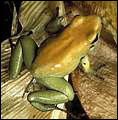 |
| Dendrobates
bicolor–one of three species utilized for poison-darts. |
Dendrobates
pumilio belongs to the family Dendrobatidae, a group commonly
known as the poison frogs or the poison-dart frogs. Though
there are over one hundred species found in this family, only
three are known to be utilized by native South Americans for
poison darts. Most are only mildly toxic or bad tasting to
predators. Many members of this family wear bold warning colors,
allowing them to move about during daylight hours without
fear of predation.
| |
|
| |
Dendrobates
vitatus with tadpoles on its back. Roll your mouse
over the image for a closeup. |
Poison
frogs have a unique habit in the amphibian world. When their
tadpoles emerge from the eggs, one of the parents allows the
tadpoles to wriggle onto its back. The adult then transports
the larvae to a suitable pool of water where the tadpoles
mature. Whether it's a bromeliad axil filled with rainwater
twenty meters above the ground or a pool of water on the forest
floor depends upon the species. The number of eggs laid, tadpoles
transported, and the sex of the transporting adult also varies
from species to species.
The strawberry
poison frog carries parental care even further. Each larva
is deposited in its own leaf axil, which minimizes competition
from siblings. The female periodically returns to each tadpole
and deposits unfertilized eggs in the leaf axil. The tadpoles
survive on this diet until they metamorphose and emerge from
their larval habitat. It was discovered in the last decade
that several species in the same group of poison frogs as
Dendrobates pumilio also share these habits.
|








 Walk
a Tropical Stream at Night
Walk
a Tropical Stream at Night